
Renewable diesel a quick switch for greener vehicles
Steamboat Resort, Arapahoe Basin see success in pilot program


Transportation is the leading source of greenhouse gas emissions in the United States and the second-highest source of greenhouse gas emissions in Routt County. The good news is that there are lots of opportunities to cut these emissions through initiatives like increased public transportation and the electrification of vehicles.
As the state works toward making fleet electrification affordable and widespread, there’s another technology some companies, like Steamboat Resort, are modeling as a practical solution to reduce emissions in the interim: renewable diesel (RD).
According to the U.S. Department of Energy, RD burns much cleaner than petroleum diesel, significantly reducing greenhouse gases, particulate matter, and nitrogen oxides. It can reduce lifecycle greenhouse gas emissions by up to 85% and reduce carbon intensity — a measure of CO2 per unit of energy — by 65% compared to petroleum diesel.
For fleet managers, especially, it presents a practical opportunity to reduce emissions without new vehicles or infrastructure investment.
Steamboat Resort and Arapahoe Basin Ski Area received the National Ski Areas Association (NSAA) Sustainable Slopes grant for $5,000 in 2025 to run a renewable diesel pilot program in their fleets, making them the first to bring RD into Colorado on a large scale for ski resort operations.
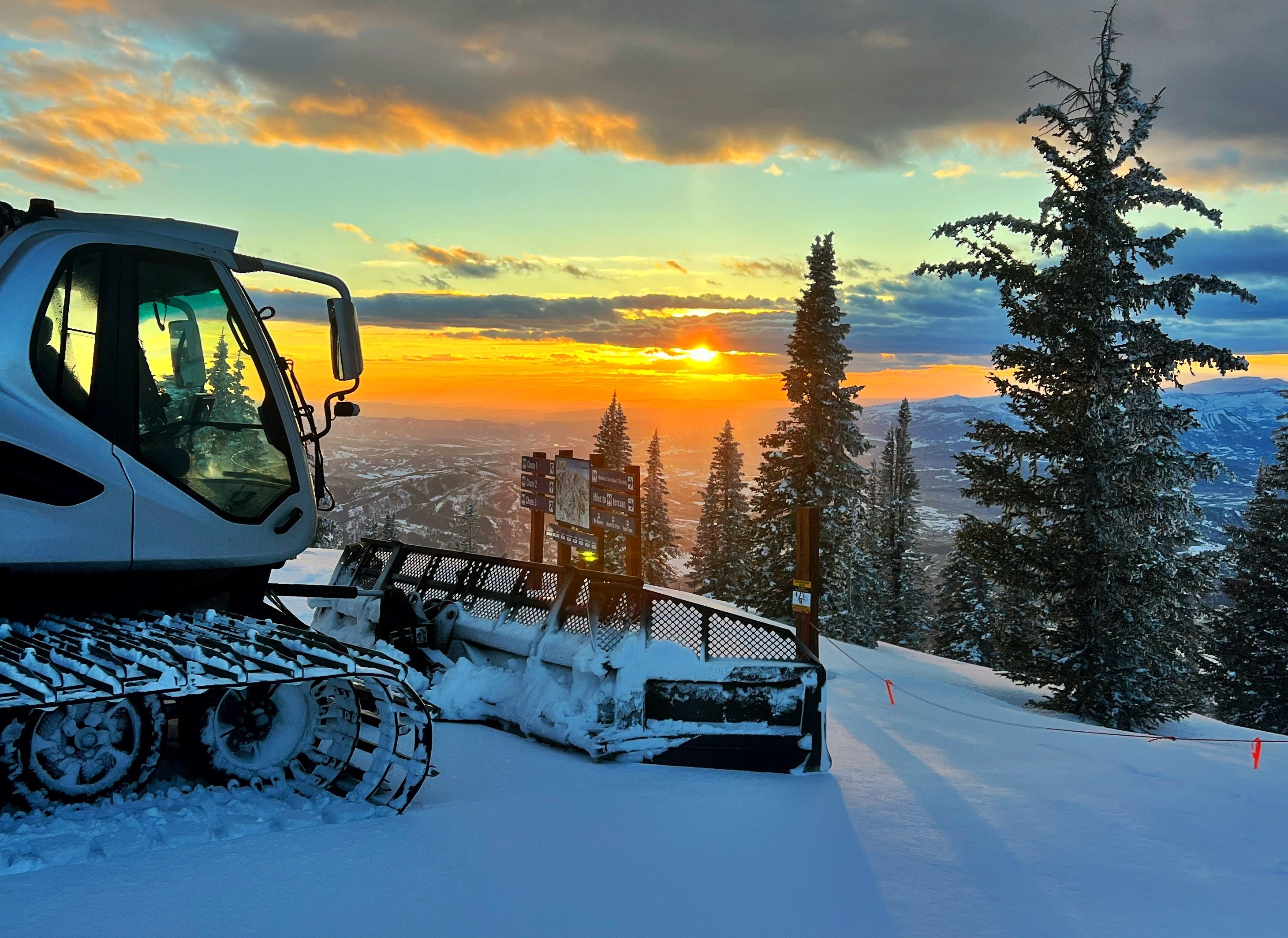
At the end of 2025, Steamboat Resort successfully piloted 3,000 gallons of renewable diesel in loaders, skid steers, and three groomers, proving RD works as a drop-in fuel replacement with no operational issues.
Renewable diesel is produced from waste and renewable feedstocks like animal fats, cooking oils, and grease through a similar hydrotreating process used to refine petroleum diesel. As stated by the U.S. Department of Energy, the result is a fuel that can directly replace or blend with conventional diesel at any ratio, compatible with existing infrastructure and diesel engines.

Another alternative to petroleum diesel is biodiesel, but it’s important to make the distinction between these two biomass fuels. Both biodiesel and renewable diesel are derived from the same feedstocks, but their manufacturing processes result in different molecular structures, therefore, yielding different results and usage requirements.
“Most diesel engines are approved to run on biodiesel blends up to B20 (20% biodiesel and 80% petrol diesel),” Western Resilience Center’s Energy and Transportation Project Manager, Tad Lane, explains.
Biodiesel’s blending limits also lead to a shorter shelf life than renewable diesel — it is prone to oxidation and water absorption, leading to gelling and solidifying in fuel lines unless combined with another substance. RD outperforms biodiesel in cold temps — remaining operable at temperatures as low as -34°C and doesn’t present the freezing or short storage life challenges biodiesel does, making it highly valuable for ski resorts and other mountain fleets in Northwestern Colorado.
“We really need to continue to drum up more demand. Engage people, bring them into the loop, and teach on the chemistry of this product, why it’s a direct drop-in replacement, why it’s super easy to transition over to this stuff.” — Ben Cavarra, Sustainability and Utilities Specialist for Steamboat Resort
Renewable diesel contains no sulfur, metals, or aromatics, so it burns completely clean with no visible exhaust smoke or smell and is expected to extend diesel particulate filter life and reduce engine fluid consumption over time. For fleets not yet ready for full electrification, renewable diesel offers a practical interim solution that delivers meaningful emissions reductions without the infrastructure overhaul that electric alternatives require.
RD can be used for county road and municipal fleets, agricultural equipment like tractors and harvesters, heavy industry vehicles like mining machinery and construction vehicles, snow groomers, long-haul freight and delivery trucks, and backup power generators.
Steamboat Resort has set goals to reach 100% renewable energy, 50% carbon reduction from its 2021 baseline, and carbon neutrality by 2030. These initiatives complement the Routt County Climate Action Plan, an intergovernmental agreement between the City of Steamboat Springs, Routt County, Town of Hayden, Town of Oak Creek, and Town of Yampa, which targets a 35% emissions reduction by 2030 and 74% by 2050. With transportation as the second largest source of emissions in Routt County at 26% of total emissions and growing, fleet electrification and clean fuels are important to achieving emissions reductions.
Bringing renewable diesel to the slopes
Ben Cavarra, Sustainability and Utilities Specialist for Steamboat Resort, explains that choosing a renewable diesel pilot over other sustainability initiatives was intentional.
Grooming represents the resort’s largest diesel use: snowcats operate 10-12 hours a day and are sometimes stationed 4,000 feet above the base overnight. Current electric snowcat options run only 2-3 hours before needing a recharge, and implementing charging infrastructure across multiple elevations on the mountain would require significant capital investment. The resort views vehicle electrification as a necessary part of its long-term decarbonization strategy, but one to pursue once the technology — comparable-weight electric snowmobiles, electric groomers, and similar equipment — advances enough to support it.
By contrast, 25-50% renewable diesel adoption across the fleet could achieve a 20-30% emissions reduction, which has a greater impact than limited EV deployment and is a meaningful step toward Steamboat’s broader decarbonization goals, Cavarra said.
Ben sees renewable diesel as a real opportunity, but getting there requires growing regional demand to make it economically viable for Colorado ski resorts and transit operations. It’s expected that as demand increases, more suppliers will enter the market, and transportation logistics will improve.
Renewable diesel in Northwest Colorado
Unlike California, Washington, and Oregon, Colorado does not have a low-carbon fuel standard, creating less economic incentive for suppliers to prioritize the state. Colorado has nonetheless moved toward cleaner fuels. State law mandates that diesel sold in nonattainment areas – areas where air pollution levels do not meet the National Ambient Air Quality Standards (NAAQS) – between June 1 and September 15 include at least 5% biodiesel (which includes renewable diesel) beginning in 2021, increasing to a 10% blend requirement statewide beginning in 2023.
Refineries in Wyoming and Montana are relatively close to Northwest Colorado; HF Sinclair’s facility in Sinclair, Wyoming, sits roughly 120 miles from Steamboat Springs. Despite this proximity, transportation logistics drive up costs significantly. Fuel is piped from Wyoming refineries to Salt Lake City before being trucked back into Colorado, adding approximately $1.50 per gallon over conventional diesel.
Without sufficient regional demand to justify new infrastructure or routes, fuel continues to be priced and routed toward established low-carbon fuel standard markets like California and the Pacific Northwest. As demand in Colorado grows, the economics of building out dedicated routes into the state improve — meaning costs are likely to decrease as more buyers enter the market.
The pilot program between Steamboat Resort and Arapahoe Basin Ski Area demonstrates that transitioning to lower-carbon fuels can work — operationally, logistically, and at scale.
“We really need to continue to drum up more demand,” Cavarra said. “Engage people, bring them into the loop, and teach on the chemistry of this product, why it’s a direct drop-in replacement, why it’s super easy to transition over to this stuff.”
Please contact Paul Bony at paul.bony@westernresilience.org and Tad Lane at tad.lane@westernresilience.org to let us know if your business is interested in a future bulk purchase consortium.
9 July 2026 | Avery Wisehart, Western Resilience Center Community Engagement Intern

Thank you to our sponsor